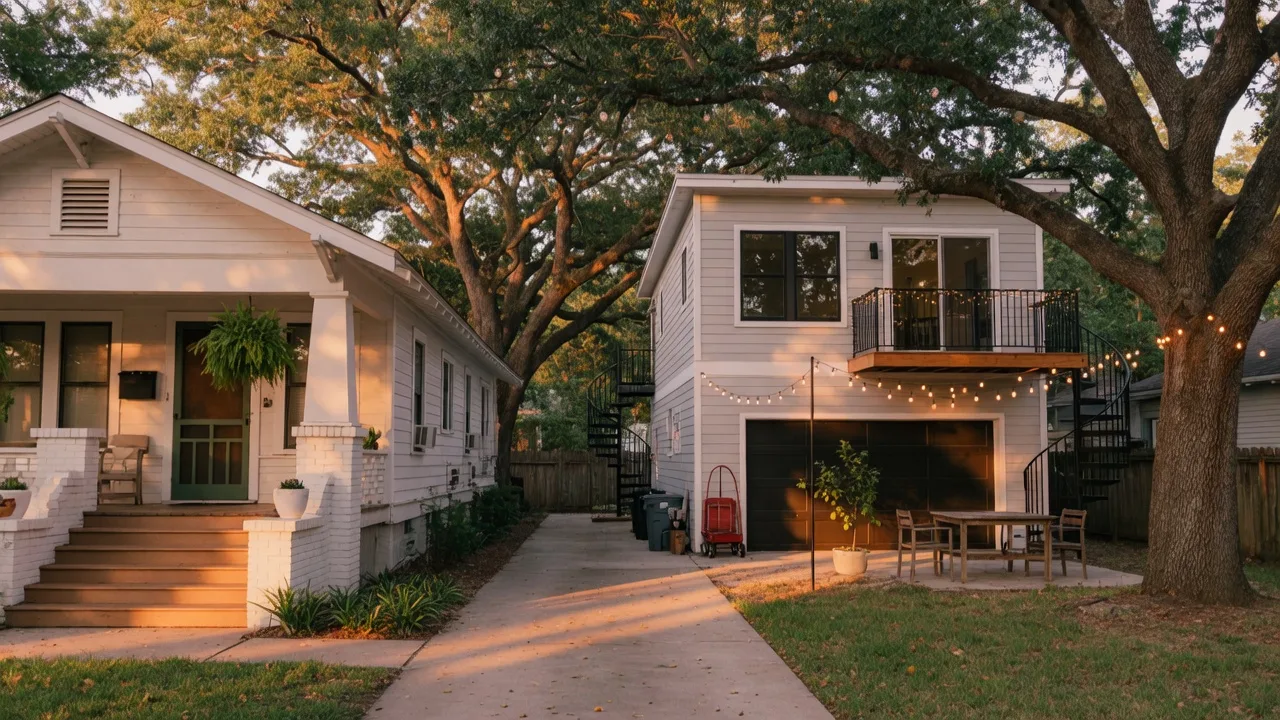

If you own a home in Houston Heights, Woodland Heights, Norhill, or another historic Inner Loop neighborhood, you have probably noticed more garage apartments popping up on the alleyways behind those classic bungalows and Victorians. What was once a dusty storage space or an oversized carport has become one of the most popular home improvements in intown Houston — a guest suite, a home office, a rental income source, or a place for aging parents to live independently. But before you start sketching floor plans, there are some important rules to understand, especially in Houston's historic districts.
What Is an ADU, Exactly?
An Accessory Dwelling Unit — often called an ADU or garage apartment — is a secondary residential unit on the same lot as a single-family home. In Houston, city code caps these units at 900 square feet and requires a working kitchen and bathroom. Whether you are converting an existing garage or building new, the unit must be self-contained.
The appeal is easy to understand. A well-built garage apartment in the Heights can rent for $1,500 to $2,200 per month, depending on finishes and location. For homeowners already sitting on an oversized lot with an alley-accessed garage, that represents a meaningful return on investment. For buyers, a property that comes with an existing ADU often commands a premium over comparable homes on the same street.
City-Wide Rules: What Applies Everywhere
Before you get to the historic district rules, every ADU in Houston must comply with Chapter 42 of the City Code. Here are the key requirements:
- Size cap: Maximum 900 square feet of gross floor area, including a kitchen and full bathroom.
- Setbacks: Minimum 5 feet from side and rear property lines, 15 feet from the front lot line, and 10 feet from the street.
- Height: Generally capped at 25 feet. Two-story detached units are possible, but deed restrictions often limit height further.
- Parking: If you convert a garage into living space, you need to maintain at least two off-street parking spaces elsewhere on the lot.
- Permits: A building permit from the Houston Permitting Center is required, along with a signed and notarized Deed Restriction Affidavit confirming no subdivision-level restrictions prohibit the ADU.
That last point is critical. Houston is the largest city in America without traditional zoning, which means deed restrictions — private covenants recorded on individual subdivisions — are the real gatekeeper. Some subdivisions in the Heights and surrounding neighborhoods cap ADUs at 500 square feet. Others prohibit them entirely. You must check your specific subdivision's deed restrictions before you invest a dollar in design work.
The Historic District Factor: What Is Different in Houston Heights
If your home falls within one of the Houston Heights Historic Districts — and many of the most desirable blocks do — the rules get more specific. The Historic Preservation Ordinance, adopted in 2010, adds a layer of review that does not apply outside designated districts.
You will need a Certificate of Appropriateness from the Houston Archaeological and Historical Commission (HAHC) for new construction, including a detached garage apartment. The HAHC reviews your plans for design compatibility with the contributing buildings on your block — massing, form, scale, proportions, and placement all matter.
In the Heights historic districts, garage apartments must be located in the rear half of the lot and should be visually obscured by the main house from the street. Driveways should run along the side of the house on interior lots. Parking pads in front of the building are considered incompatible with the historic character of the district.
There is some good news: per the 2018 Design Guidelines, detached garages up to 400 square feet and garage apartments up to 400 square feet are excluded from lot coverage calculations. That means a modest ADU won't push you over your lot's maximum building footprint.
Who Is Building ADUs in the Heights?
We are seeing three main use cases among our clients and neighbors:
- Multigenerational living. Adult children moving back in with their parents, or aging parents downsizing into a detached suite on a family member's property. The ADU provides independence while keeping family close.
- Home office or creative studio. With remote work still reshaping how Houstonians use their homes, a dedicated detached space away from the main house has become a premium amenity.
- Rental income. For homeowners who want to offset their mortgage or generate supplemental income, a short-term or long-term rental ADU is increasingly popular — though short-term rentals may face additional deed restriction or HOA limitations.
What Buyers Should Look For
If you are shopping for a home in Houston Heights, Garden Oaks, Oak Forest, or Timbergrove and an existing ADU is part of the appeal, here is what we tell our buyer clients:
First, verify that the unit was permitted. An unpermitted garage conversion might look nice, but it can create headaches at resale or during your homeowner's insurance renewal. Ask your agent to pull permits through the city. Second, confirm the ADU is not violating the subdivision's deed restrictions — if it is, the next owner could be forced to remove it. And third, understand the historic district status of the property, if any, and what that means for future changes you might want to make.
A properly built and permitted garage apartment can be a fantastic asset. One that cuts corners on code or deed restrictions can become a liability.
The Bottom Line
Garage apartments and ADUs are adding a new dimension to the Houston Heights luxury and mid-range home markets. They offer flexibility that matches how modern families actually live — and in a built-out historic neighborhood where new land is scarce, they represent one of the few ways to add square footage and functionality to an existing property.
But the rules are real, and they vary block by block. The Shawn Manderscheid Team has helped dozens of homeowners and buyers navigate the intersection of deed restrictions, historic district requirements, and market value — and we know which subdivisions allow ADUs and which do not. Get in touch if you are considering an ADU project or looking at a property with one. We would be happy to share what we know.
"With us, you're not a number but a neighbor."
— Shawn Manderscheid